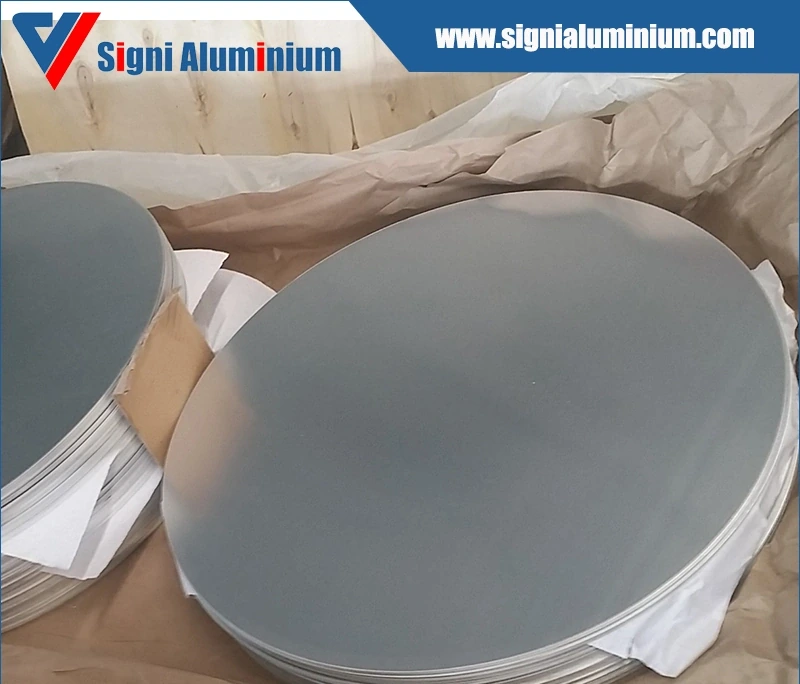
Aluminium circles are blanked from coil and sheet for deep drawing — overwhelmingly for cookware in this catalogue: the storefront's disc listing is a 3004 disc for food network pots and pans, and circles are punched from strip on the blanking line. The company's full-range and English sites publish the circle plate range by series: 1000 series (1050, 1060, 1070, 1100, 1200), 3000 series (3003, 3004), and 4000, 5000 and 6000 series circles.
Circle plate specifications (supplier's listing)
| Alloys listed | 1050, 1060, 1070, 1100, 1200; 3003, 3004; plus 4000/5000/6000 series |
|---|---|
| Example specification | Alloy 4006, temper H22/O |
| Thickness (example) | 0.8–9.0 mm |
| Diameter (example) | 80–1200 mm |
| Surface (example) | Mill finish |
| Headline disc listing | 3004 aluminium disc/disk for pots and pans |
The example specification above is quoted as published — it belongs to one circle plate listing and shows the format of the data (alloy, temper, thickness, diameter, surface), not a promise that every diameter is available in every alloy. Cookware buyers usually fix three things first: the alloy (3003 and 3004 dominate the published cookware disc listings, with 1050/1060/1100 for simpler drawn parts), the temper for the draw depth they run, and the diameter/thickness pairing from their tooling. Send those three and the quotation can be built directly on the circle listings.
Circles are blanked from the coil stock and sheet ranges, and the company's own site describes aluminium circles for cookware as one of its headline product lines.
From coil to circle
Circles are blanked, and blanking economics shape how they are quoted. The process is straightforward: strip feeds a press, circles are punched out, and the punched skeleton leaves as scrap. The diameter and the strip width together decide the yield, which is why circle quotations ask for diameter and thickness before anything else — a small change in diameter can move a circle to a different strip width and a different yield. If you order several diameters in the same alloy and temper, listing them together in one enquiry lets the quotation group them by strip width.
Temper choice follows the draw. The circle plate listing's example pairs its alloy with H22 and O tempers — a quarter-hard temper for shallower draws and the annealed temper for deep draws — and the cookware listings in this catalogue (3003, 3004) are the grades whose tempers cookware makers usually qualify first. State the draw depth or the finished part when you enquire; it is the fastest way to land on the temper the listing should be quoted in.
Packing is interleaved for a reason: the disc photograph on this page shows circles stacked with paper interleaving in the crate, which protects the drawing surface of the blank. If your process feeds discs automatically, mention the stack format you need when you enquire.
Are discs and circles different products?
No. Disc, circle and circle plate name the same round blank; the listings use all three terms for the one product.
What diameter range is published?
The circle plate listing's example specification gives 80–1200 mm diameter at 0.8–9.0 mm thickness. Other alloys and tempers are confirmed per enquiry.
Which alloy should a cookware buyer choose?
The documented cookware disc listing is 3004; 3003 and the 1xxx grades are also listed for circles. The draw depth and coating line you run decide between them — describe both in the enquiry.
Get a written quotation
Send the alloy, temper, thickness, width and quantity you need. Quotations state the applicable minimum order and lead time for that exact specification.
Request a quotation for this product