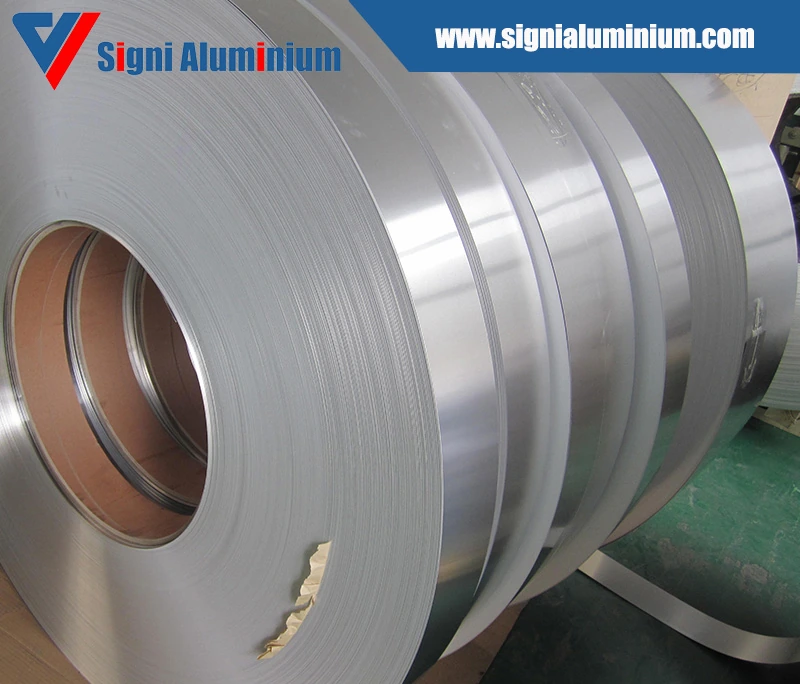
Heat-exchange fins are made from two kinds of material in this catalogue, and the listings keep them separate. The first is plain fin stock: a dedicated storefront listing for a 1100 aluminium strip coil for fin stock — unclad 1xxx strip for fins that are mechanically joined or used in non-brazed assemblies. The second is clad fin material: a 4343/3003/7072 clad aluminium sheet strip, published as evaporator fin material under a title stating a 4–30% clad range — a brazing-sheet construction where the 3003 core carries the strength and the clad layers provide the brazing surface.
Fin stock — documented listings
| Plain fin stock | 1100 aluminium strip coil for fin stock (storefront listing) |
|---|---|
| Clad fin material | 4343/3003/7072 clad sheet strip for evaporator fin material |
| Clad construction | Clad range 4–30% (as published in the listing title) |
| 1100 fin coil dimensions (listing) | Thickness 0.07–0.25 mm in the description table (attributes: 0.18–0.2 mm), with the partially annealed sub-range stated separately at 0.10–0.25 mm; width from 100 mm (attributes: 100–1220 mm); tempers H14 / H18 / H0 |
| Strip family context | Heat exchange aluminium strip is listed in the full-range site's strip family |
| Clad fin gauges | Set with the construction at quotation |
The clad fin material belongs to the same family as the brazing sheet page: both are 4343/7072-on-3003 constructions, sold once as fin material for evaporators and once as brazing sheet and strip. If your fin is brazed, the brazing page carries the family context; if it is a plain mechanically-expanded fin, the 1100 fin stock coil is the documented product. Naming the joining method in the enquiry is the fastest way to the right listing.
Fin stock is a strip product, so its ordering logic follows the strip page: alloy and temper, gauge, finished width, coil inside diameter and maximum coil weight for your fin press. The 1100 fin coil listing publishes its dimensions (thickness 0.07–0.25 mm in its description table, 0.18–0.2 mm in its attributes, with a partially annealed sub-range of 0.10–0.25 mm stated separately in the same table; widths from 100 mm, attributes 100–1220 mm; tempers H14, H18, H0); the clad fin material's gauges are set with its construction at quotation.
Fin stock and the heat-exchange strip family
The full-range site's strip family includes a dedicated heat exchange aluminium strip entry, which places fin material in the catalogue's own structure: fin stock is not an afterthought product but one of the named strip applications, published alongside dedicated fin listings. For the buyer, the practical division is by fin geometry and joining. Plain fins — stamped, louvered or corrugated, mechanically expanded onto tubes — run on the 1100 fin coil. Brazed fins in controlled-atmosphere brazing furnaces run on the clad construction, where the 4343 layer melts and the 7072 layer protects the 3003 core; the 4–30% clad range in the listing title is the published construction data, and the per-side clad details are fixed at quotation. Fin gauge tolerance matters more than in most strip buying because fin height and collar formation consume it — state your gauge tolerance explicitly rather than relying on a general strip tolerance, and it will be answered against the fin listings specifically.
Plain or clad fin stock — which do I need?
Brazed assemblies use the clad construction (4343/3003/7072); mechanically joined fins use plain stock such as the documented 1100 fin coil. State the joining method in the enquiry.
What does the 4–30% in the clad listing's title mean?
The title states a range: clad layers making up 4–30% of the composite — not a single fixed ratio. The construction details for your specification are confirmed when enquiring.
Are fin stock gauges published?
For the 1100 fin coil, yes: 0.07–0.25 mm thickness in the listing's description table (0.18–0.2 mm in its attributes), with the partially annealed sub-range stated at 0.10–0.25 mm, and widths from 100 mm (attributes 100–1220 mm). The clad fin material's gauges are set with its construction at quotation.
Get a written quotation
Send the alloy, temper, thickness, width and quantity you need. Quotations state the applicable minimum order and lead time for that exact specification.
Request a quotation for this product