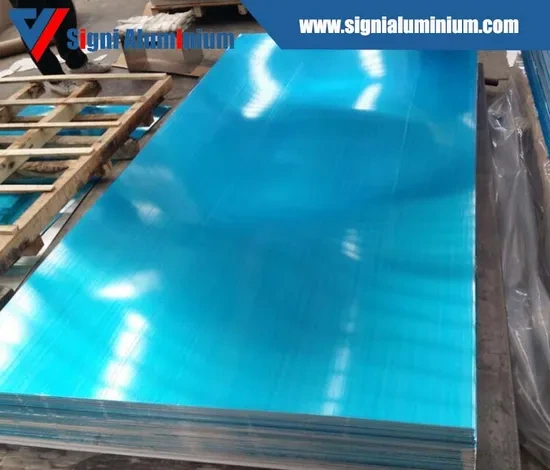
The English site's mirror aluminum plate sheet listing publishes two alloy classes — 1085 and 1070 — at thickness 0.3–1.0 mm and width 250–1500 mm, with a bright finish. Its product description makes the production point explicitly: the material is produced as mirror sheet, so it avoids a separate polishing step at the buyer's end. That is the commercial content of the listing — mirror finish as a mill product, not as a post-process.
Mirror sheet specifications (supplier's listing)
| Alloys | 1085, 1070 |
|---|---|
| Thickness | 0.3–1.0 mm |
| Width | 250–1500 mm |
| Surface | Bright finish (mirror) |
| Production note | Mirror material produced in-house; no separate polishing step required (listing description) |
| MOQ & lengths | Confirmed per enquiry |
Mirror sheet is a finish-critical product, and the honest way to buy it is against a sample: reflectivity and surface defect tolerance are judged visually, and the listing's figures (alloy, thickness, width) do not capture them. The catalogue's own packing photographs show bright sheet handled under protective film, as in the photograph above; state in the enquiry whether film is required and whether one or both faces must be mirror — the listing describes the product family, and the order fixes the faces.
Mirror sheet neighbours: the polished sheet listing (1050/3003/3150/5052/6061/8011) covers the polished rather than mirror route, and the anodized sheet page covers the brush-finish anodised products. If the application is lighting reflectors, decorative panels or signage, say which — the finish families divide along exactly those lines.
Mirror sheet among the bright finishes
Three bright-finish routes exist in this catalogue and they are not interchangeable. Mirror sheet, this page, is the 1085/1070 product at 0.3–1.0 mm whose listing stresses that the mirror is produced as the material itself — no separate polishing step at the buyer's end. Polished sheet is the broader grade set (1050, 3003, 3150, 5052, 6061, 8011 on the English site) where polishing is the finish process applied to standard alloys — the route when the alloy is fixed by the application and the brightness is secondary. Anodised finishes, on the anodized sheet page, are the third route: a converted surface rather than a polished one, documented here in a copper brush finish. A lighting or decorative buyer should decide which route the design intends before comparing prices, because the three routes price differently and age differently; the listings' own data — mirror's narrow alloy pair and thickness band versus polished sheet's six alloys — already shows they are different products wearing similar names.
Buying mirror sheet well means separating the published facts from the judged ones. Published: 1085/1070, 0.3–1.0 mm, 250–1500 mm, bright finish, produced as mirror material. Judged: reflectivity, orange-peel, scratch tolerance — properties assessed on a sample under your lighting, which is why first orders of finish-critical sheet are normally sample-led. State the application (reflector, decorative panel, signage) and the viewing distance in the enquiry; both shape what 'mirror' has to mean for the order to succeed, and neither is reducible to a number the listing could have printed.
What thickness is mirror sheet published in?
0.3–1.0 mm, in 1085 and 1070, widths 250–1500 mm.
Does mirror sheet need polishing after delivery?
The listing states the material is produced as mirror sheet and avoids a separate polishing step. Judge the finish against a sample for critical work.
Is protective film standard?
Bright sheet in this catalogue is photographed and handled under film; state your film requirement in the enquiry.
Get a written quotation
Send the alloy, temper, thickness, width and quantity you need. Quotations state the applicable minimum order and lead time for that exact specification.
Request a quotation for this product