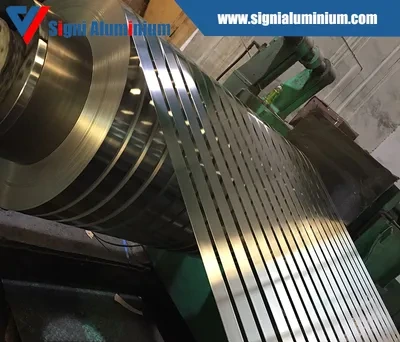
Most narrow aluminium strip does not start narrow: it is slit from a wide mother coil. Signi's published range lists slit coil and slit strip as products in their own right, fed by grade-listed mother coil (the structured grade listings publish mother coil up to 2300 mm wide). The slitting photograph on this page comes from the supplier's own air duct strip listing — spiral duct strip is one of the standard outputs of a slitting line, alongside fin strip, cable strip and stamping blanks feedstock.
What to fix before ordering slit coil
- Finished widths and tolerance — the grade listings publish width tolerance on the mother coil (the 1060 listing states +2/−0 mm), and the slit listing itself publishes a ±0.127 mm tolerance across its processing sizes; the tolerance held on your finished widths is confirmed in the quotation.
- Coil inside diameter — mother coil IDs on the listings are 76/152/408/508 mm; state the ID your line takes.
- Edge condition — the 1350 transformer strip listing specifies edges round, free from burr; if your application needs a dressed edge, name it in the enquiry.
- Packing orientation — listings offer eye to sky or eye to wall; pick the one your decoiler handles.
Slit coil is a conversion of a listed mother coil, and the published listings do not state a separate minimum order for slit coil as a finished product — the minimum for your slit widths is confirmed in the quotation against the mother-coil grade you specify. Splitting one mother coil across several finished widths is the normal way buyers build a width programme; say in the enquiry if you want a multi-width split quoted.
Slit coil in the published range
The documented outputs of slitting in this catalogue are the named strip products: air duct strip in 8011, 1100 and 3003 (a Made-in-China listing published for spiral duct production), fin strip for heat exchange (covered on the fin stock page, including the 1100 fin stock coil listing), cable strip, and the narrow transformer strips in 1050, 1060, 1070 and 1350 published on the full-range site. Each of those end products starts as a grade-listed mother coil, so a slit coil enquiry is really two specifications in one: the mother coil grade and temper, and the finished width programme.
Coil weight is the third figure to settle. The 3003 grade listing publishes about 0.3–2.5 tons per pallet for its packed format, and slit coils are normally packed to the buyer's decoiler limit rather than to a catalogue figure. State the maximum coil weight and the inside diameter together — a width programme that ignores coil weight produces coils your line cannot lift, which is the most common avoidable problem in slit coil orders.
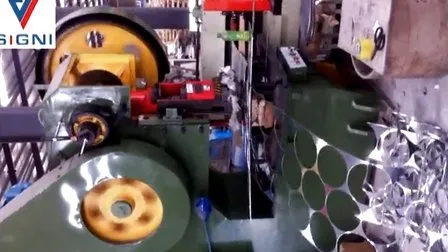
Finally, when you compare slit coil quotations, two offers at the same finished width are only comparable when the alloy, temper, tolerance and coil format behind them are the same — and the slit listing publishes figures of its own for all four. Its technical specifications give thickness 0.3–3 mm, width 200–800 mm and tempers O, H24, H18, H111 and H14 across alloys 1100, 1050, 1070, 3003, 3004, 3105, 3005, 5005, 5052 and 5754; its processing sizes run from 0.25 mm gauge and 10 mm width at ±0.127 mm tolerance; and its finished-product parameter table gives strip thickness 0.2–5.0 mm, strip width 20–2750 mm, an edge cut of 10–50 mm, coil inside diameter 508 mm and outside diameter 1200–2600 mm. Those figures describe the slit conversion; the mother-coil grade behind the order is still fixed against the grade listing in the quotation.
Can one order combine several slit widths?
That is the usual pattern: one mother coil grade and temper, several finished widths. List the widths and the approximate tonnage split in your enquiry.
Which alloys are slit most often?
The application strips in the published range point to 1xxx grades for electrical and duct work, 3003 for duct and general forming, and 8011 for duct and foil-adjacent uses — the grade listings govern availability.
Does slit coil come with a test certificate?
The listings name the mill test certificate among the documents supplied; request it explicitly for your order if your QA system requires it.
Get a written quotation
Send the alloy, temper, thickness, width and quantity you need. Quotations state the applicable minimum order and lead time for that exact specification.
Request a quotation for this product