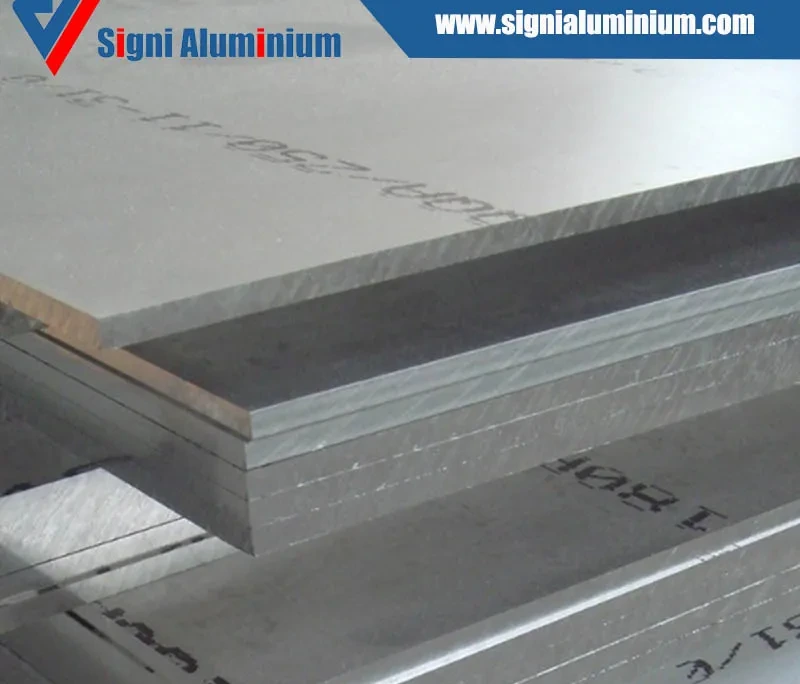
Coil pricing is dominated by rolling passes; plate pricing is dominated by what the plate is for. The same ton of aluminium is worth different money as 6 mm 5052 sheet-plate, as 100 mm 5083 marine plate, and as 6061 mould plate — not because the metal differs much, but because the production route, the inspection burden and the cutting programme differ entirely. Buyers who understand the four levers below — thickness route, alloy family, condition, cutting — can read a plate quotation the way the supplier wrote it.
Lever one: thickness and the hot rolled route
Plate is hot rolled, and thickness is its first price fact. This catalogue's plate programme spans an unusually wide band: the 5052 listing runs 0.5–150 mm, and the marine plate data on the platform profile runs 6–300 mm thick, 500–2700 mm wide and 1000–10000 mm long. Thin plate behaves commercially like heavy sheet — priced close to coil logic. Thick plate is a different product: fewer pieces per heat, slower rolling, individual handling, and flatness discipline that grows harder with every millimetre. Per-ton price rises with thickness at the heavy end, which surprises buyers used to steel, where thick is often cheaper. In aluminium plate, thick, wide and flat is the expensive corner of the catalogue, and quotations should be read that way.
Lever two: alloy family — 5xxx marine versus 6xxx machining
The marine alloys (5052, 5083, 5754 in this catalogue) price on their magnesium content, their corrosion performance and, for classed work, the buyer's documentation regime. 5083 is the premium of the family — the grade page publishes its programme separately, including a historical listing minimum of 3 MT for a single product — and 5454 sits as the tank-and-vessel alternative: its grade page publishes composition rather than dimensions, while the tanker listing adds a 5454T size row (4–8 mm) and a 3-ton listing minimum — so it is quoted against the specification, not off a shelf. The 6xxx route (6061 sheet and mould plate) prices differently: the metal is a general engineering alloy, but mould plate adds sawn edges, thickness tolerance discipline and the flatness a mould base needs. Neither family is 'the expensive one' — a thin 5052 plate can price below a precision 6061 mould plate per ton — but the reasons for the price are different, and mixing the two families in one comparison hides them.
Lever three: condition — temper and stress relief
Plate condition is a priced option. The 5052 listing publishes O alongside H111, H112, H114 and the H32–H38 ladder; each is a different amount of work and a different product. For machined plate, the stress-relief question dominates: plate supplied in a stretched, stress-relieved condition (the T651 logic in the temper guide) costs more than the same alloy unrelieved, and earns it the first time an unrelieved plate moves on the machine. The marine programme's stretched variant — published at 6–70 mm within the 6–300 mm marine band — exists for the same reason: large welded fabrications need plate that stays where it was put. A quotation that does not state the condition is incomplete in the same way as one that does not state the alloy.
Lever four: cutting and the per-ton / per-piece question
Most plate is not shipped as full plates. It is sawn, sheared or water-jetted into a cutting list, and the cutting programme is a real cost line: machine time, blade and abrasive, nesting yield, and the skeleton that comes back as scrap credit or not. This is where per-ton and per-piece pricing diverge. A per-ton price for full plates is the clean metal-plus-rolling number; a per-piece price for cut blanks folds in cutting and yield. Comparing a per-ton full-plate quote with a per-piece cut quote without restating the cutting programme is the plate equivalent of comparing FOB with CIF. State the cutting list — every blank size and count — in the enquiry, and ask for the basis to be named: full plate per ton, or cut pieces per piece, with offcut ownership stated.
Published ranges, price tiers — and pricing by quotation
The plate listings behind this site publish ranges, widths, packing (about 2 mt per pallet on the 5052 listing) and minimums where they exist; the platform's product pages also publish per-ton price tiers for individual products — the marine plate listing, for example, tiers its price by tonnage. A tier on a listing is a starting band, not a price for your specification, and this site publishes no prices. That is not evasion: a plate price is a function of the four levers above plus the day's metal benchmark, and a printed table would be wrong for most real specifications by the time it was read. The useful discipline is the buyer's: fix the alloy and condition from the grade pages, write the cutting list, state the tonnage against the published minimums, and let the quotation price exactly that. The coil pricing note in this blog covers the benchmark and freight legs that plate shares with coil.
Lever five: width, length and the super-size corner
Plate dimensions price independently of thickness. The marine programme's published band — widths to 2700 mm, lengths to 10000 mm — reaches sizes that only wide mills produce, and super-wide or super-thick hard alloy plate is named in the platform profile as one of this supplier's range strengths. Wide plate costs more per ton than standard-width plate of the same alloy because fewer mills roll it, nesting yield on a cutting list improves with width (a genuine offsetting saving — wide plate can waste less), and handling single 10-metre plates is its own operation. The net effect is project-specific: a cutting list that nests efficiently on 2700 mm plate may land cheaper per finished blank than standard plate with worse yield, even at a higher per-ton price. This is the strongest argument for sending the cutting list with the enquiry rather than after it: the width decision is a price decision, and it can only be priced against the real nesting.
A note on marine documentation
Marine plate buyers sometimes arrive with a classification-society certificate requirement. This supplier's published material lists its management systems (ISO 9001, and ISO 14001 on the company website) and platform audit status; this site does not claim marine classification certification for the plate programme. Where a project specification requires class certification, that requirement belongs in the first enquiry, priced and answered as a documentation question — not discovered at delivery. General marine-grade supply (the 5xxx programme itself) and class-certified supply are different offers with different prices, and a quotation for one is not evidence about the other.
Keep the five restated lines from the coil note — benchmark date, alloy and condition, dimensions, quantity, terms — and add the cutting list as the sixth line; a plate comparison with all six aligned rarely misleads.
Get a written quotation
Send the alloy, temper, thickness, width and quantity you need. Quotations state the applicable minimum order and lead time for that exact specification.
Request a quotation for this product