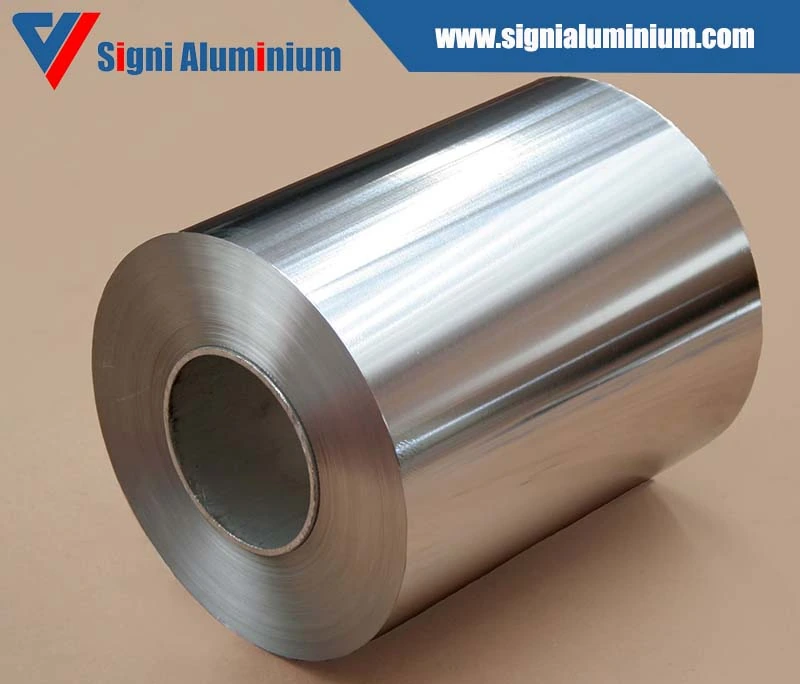
Ask a foil supplier for 'packaging foil' and you have asked for three different products at once. The foil that becomes a ready-meal tray, the foil that becomes a bottle cap, and the foilstock that a packaging converter laminates into pouches and wraps are related — all are thin aluminium, all come from the same foil mills — but they are specified differently, alloyed differently and bought by different people. The supplier's published listings keep the three branches separate: a 1235/8011 jumbo roll for food containers, a lubricated foil in 1100/3003/8011, a cap closure foil/sheet in seven alloys, and a food packaging foil described as foilstock.
Branch one: container foil
Container foil is the forming branch. Its documented route in this catalogue starts with the jumbo roll — 1235 and 8011 foil sold for food container production — which tray manufacturers slit and press into containers. The alloy pairing is the industry's standard answer: 8011 brings the strength and pinhole performance foil gauges need, 1235 the purity of the 1xxx foil family. Alongside the standard roll, the catalogue lists a lubricated aluminium foil in 1100, 3003 and 8011 for air duct and food container use. Lubrication is a production property, not a marketing word: on a container press, the foil must draw into the die without galling or tearing, and the lubricant film is part of how that is achieved at line speed. A container foil enquiry should therefore say whether the foil is wanted lubricated or standard, the tray format and depth (which set the gauge and temper the forming needs), and the roll format the press unwinds. The container foil listings publish gauges as well as alloys — 0.006–0.06 mm in the jumbo roll listing's description and 0.006–0.09 mm in its attribute field, two figures that conflict, so neither governs until the quotation confirms one — and the lubricated foil listing states 0.006–0.06 mm in its attribute field, against 0.08–0.2 mm in its description text and 0.18–0.25 mm in its dimension table, a conflict inside that listing as well. The exact gauge and tolerance for a tray order are therefore confirmed in the quotation.
Branch two: cap closure foil
Cap closure is the deep-drawn, printed branch: the English site lists aluminium cap closure foil/sheet in 1060, 1070, 3004, 3105, 5052, 5182 and 8011. Read the alloy list as a capability statement — it spans the purity of 1060/1070, the manganese strength of 3004/3105, the magnesium alloys 5052/5182 used where cap stock needs their forming and corrosion balance, and the foil family's 8011. Cap stock is bought against the cap: diameter, draw depth, knurling and the printing or lacquering the cap will receive. The listing's breadth means the enquiry conversation can start from the cap drawing rather than from an alloy shortlist — but it also means the alloy must be named in the order, because seven listed alloys are seven products, not one.
Branch three: packaging foilstock
The third branch is foil as a converter input: the English site's food packaging product is described as aluminium foil (foilstock) supplied to the packaging, technical and construction industries. Foilstock is the wide roll the converter laminates, prints, coats or embosses — the foil inside flexible packaging structures, insulation facings and technical tapes. Its specification logic is the industrial logic of the companion guide in this blog: alloy, temper, gauge and tolerance, roll format, surface condition. What packaging buyers add is the downstream process — the lamination adhesive, the print system, the sealing layer — because the foil must bond and run in a structure, not merely exist. Naming the structure (even generically: foil/paper, foil/film) in the enquiry gets a more useful quotation than naming the end product.
What ties the branches together — and what must not be mixed
All three branches draw on one foil programme — the supplier's own website describes a high-precision foil and strip project in production since March 2005 with 100,000 tons of annual capacity for that project — and one enquiry can legitimately cover several branches for a packaging group that runs trays, caps and lamination. What must not be mixed is the data. The cap closure alloy list does not make 5182 a container foil; the lubricated listing's alloys do not redefine the jumbo roll's 1235/8011 pairing; and no branch inherits another's minimums or terms. A well-written multi-branch enquiry therefore lists the branches as separate lines, each with its own alloys and formats, and quotes each branch against its own listing's figures.
The specification checklist for packaging foil, branch by branch: containers — alloy (1235/8011 route or the lubricated 1100/3003/8011 route), tray format, gauge and temper as the forming needs them, roll format; caps — the cap drawing, alloy from the seven listed, surface and print/lacquer intent; foilstock — alloy, temper, gauge and tolerance, jumbo or slit format, and the structure it will join. Send that, and packaging foil stops being one vague phrase and becomes three priceable products.
Gauge, pinholes and the barrier question
Packaging foil is a barrier material, and its central technical fact is the pinhole: below certain gauges, rolled foil contains microscopic holes whose count rises as gauge falls. For most food packaging this is managed by structure — the foil is laminated to paper or film, and the laminate, not the foil alone, is the barrier the shelf life is calculated on. The buying consequence is that gauge selection in packaging is a joint decision between the foil supplier's range and the converter's structure design: specifying the thinnest possible foil without the structure conversation transfers cost from metal to rejects. This supplier's foil listings publish gauge figures for the container branch — 0.006–0.06 mm in the jumbo roll listing's description (0.006–0.09 mm in its attribute field) and 0.006–0.06 mm in the lubricated foil listing's attribute field, whose own description text and dimension table state 0.08–0.2 mm and 0.18–0.25 mm — and because those figures conflict, the gauge is agreed per order against the figure the quotation confirms, together with the structure — tray, cap or laminate — it will serve. Buyers should bring the structure to the enquiry; it is the document that makes a packaging foil quotation accurate.
Formats: from jumbo roll to the converter's line
Packaging foil moves through the supply chain as jumbo roll and leaves it as slit widths, blanks and formed containers. Each conversion step is a priced service with its own yield: slitting wide foil to narrow widths, blanking cap stock, lacquering or printing where the order calls for it. A packaging group comparing suppliers should compare at the same conversion stage — jumbo roll against jumbo roll, slit against slit — because a finished-width price and a jumbo price for the same foil differ by the conversion and its yield, not by the metal. The container branch's documented route (jumbo roll for container production) and the foilstock branch (wide roll for converters) are both first-stage formats; buyers without in-house slitting should state finished widths in the enquiry and have the slitting priced in, rather than priced later as a surprise.
In short: name the branch, name the alloy from that branch's own listing, and bring the application document — tray format, cap drawing or laminate structure. Those three habits turn packaging foil from a commodity argument into a specification both sides can price and deliver against.
Get a written quotation
Send the alloy, temper, thickness, width and quantity you need. Quotations state the applicable minimum order and lead time for that exact specification.
Request a quotation for this product