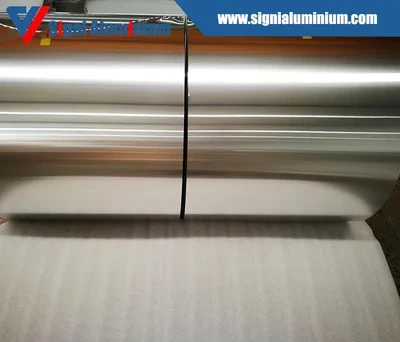
Aluminium foil is usually introduced as a packaging material, but a large share of foil tonnage never wraps food: it becomes heat-exchange fins, cable wrapping, insulation facings, ducting, honeycomb cores and brazing composites. Industrial foil is also specified differently from retail foil. Nobody buys it by the box or by brand; converters buy it by alloy, temper, gauge and roll format, against a forming or laminating process it has to survive. Those four specification elements run through the foil products one Henan supplier's listings document — 1235/8011 jumbo roll, lubricated foil in 1100/3003/8011, 1100 fin stock coil, and 4343/3003/7072 clad fin material.
Alloy: the 1xxx and 8xxx families do the work
Industrial foil alloys cluster in two families. The 1xxx family (1235, 1100) is high-purity aluminium: soft, highly conductive, corrosion resistant, and the default for electrical and general conversion work. The 1235 listing in this catalogue cites the foil strip standard references QQ-A-1876 and ASTM B479 — a reminder that foil strip is a standards-governed product, and that a foil enquiry should name the standard it buys to where one applies. The 8xxx family (8011, 8079) is the foil specialist family: iron-and-silicon-bearing alloys rolled specifically for foil gauges, with the balance of strength and pinhole performance that thin foil needs. The 8011 strip listing publishes the alloy's tempers (H0, H18, H14, H24, H16) across its strip range. 3003 appears where foil needs more strength than 1xxx offers — in this catalogue, in the lubricated foil listing alongside 1100 and 8011.
Temper: the forming decision
Foil temper decides whether the foil forms, folds or springs. O (annealed, written H0 in some listings) is the dead-soft condition for deep forming and lamination — the foil stays where it is put. The H1x tempers (H14, H16, H18) are progressively harder, for foil that must hold a shape, resist tearing on a fast line, or provide stiffness in a fin or a cable wrap. H2x tempers (H24 in the 8011 set) are strain hardened then partially annealed back — a middle route used where some forming follows the rolling. The practical rule: specify temper from the process, not from habit. A container line wants formability; a fin press wants collar-forming without splitting at production speed; a lamination line wants a foil that will not stretch under tension. The temper guide on this site explains the code system in full; the foil-specific lesson is that the same alloy at the same gauge in O and in H18 is two different production materials.
Gauge: specified, not assumed
Foil gauges are measured in microns and bought to tolerance, and they are the specification element buyers most often leave vague — 'standard foil gauge' does not exist. What gauge does in service: it sets pinhole count (thinner foil, more pinholes — the reason barrier applications specify gauge floors), stiffness, forming force, and metal cost per square metre, which falls as gauge falls. This supplier's jumbo roll listing does publish gauges — 0.006–0.06 mm in its description and 0.006–0.09 mm in its attribute field, two figures that conflict — and the lubricated foil listing states 0.006–0.06 mm in its attribute field, against 0.08–0.2 mm in its description text and 0.18–0.25 mm in its dimension table, so that listing's own sections conflict as well. Gauge and tolerance are therefore stated by the buyer against the application, and the quotation confirms which published figure governs the order. A converter switching suppliers should send the running gauge and tolerance exactly as specified to the incumbent — foil is the product where 'equivalent' substitutions fail first, because line settings are tuned to a gauge and a temper together.
Format: jumbo roll is a production input
Industrial foil is traded as jumbo roll — wide, heavy rolls that the converter slits and rewinds — and the format terms matter as much as the alloy. Core size, maximum outside diameter and roll width decide whether the roll runs on your unwinder at all. The documented jumbo roll product here is the 1235/8011 roll for food container production, and the same foil programme supplies foil stock (foilstock) to the packaging, technical and construction industries through the English site's listing. Buyers with their own slitting buy jumbo width and full rolls; buyers without specify finished slit widths and let the slitting route on the slit coil page's logic apply — foil slitting is its own discipline, and finished-width foil should be quoted as such rather than as jumbo roll plus an assumption.
The specialist end: fin stock and clad foil
Two documented products mark the industrial end of this foil programme. The 1100 strip coil for fin stock is plain foil-family strip for mechanically joined heat-exchange fins. The 4343/3003/7072 clad sheet strip — published as evaporator fin material under a title stating a 4–30% clad range — is foil technology at its most engineered: a core that carries strength, clad layers that melt and protect in the brazing furnace. Between them they show the range of 'industrial foil' as this supplier uses the term: from commodity 1xxx foil stock to a three-alloy clad construction. The fin stock and brazing sheet pages carry each product's own data; the packaging side of foil is a separate guide in this blog.
A final specification checklist: alloy and any governing standard; temper from the process; gauge and tolerance in microns; jumbo or slit format with core and diameter; surface condition (the lubricated option exists in this catalogue for forming work); and quantity against the listing's terms. Send those six lines and an industrial foil enquiry is complete enough to price.
Surface and treatment options that change the order
Two surface decisions recur in industrial foil buying. The first is lubrication: this catalogue's lubricated foil listing (1100/3003/8011, published for air duct and food container work) exists because drawn and formed foil behaves differently with a lubricant film, and a converter whose line was set up for lubricated stock should not silently accept dry foil as equivalent. The second is the surface state for bonding: foil destined for lamination or coating is specified by its surface condition, and foilstock orders (the English site's packaging, technical and construction foilstock listing) normally state the treatment the converter's process expects. Neither decision appears in an alloy-and-gauge shorthand; both belong in the enquiry text. A third, quieter point: foil for electrical uses (the catalogue's transformer strip is the heavy-gauge neighbour of this family, at 1350 in temper O) is specified on conductivity behaviour, which is why the 1xxx purity grades dominate it — alloy purity is a performance specification there, not a cost saving.
Finally, a word on continuity: foil lines are tuned to a material, and requalification after a supplier change costs line time. Converters who document their running specification fully — the six lines above — can hold a second source qualified in reserve at low cost, which is worth more in a disruption than a small difference in the per-ton price.
Get a written quotation
Send the alloy, temper, thickness, width and quantity you need. Quotations state the applicable minimum order and lead time for that exact specification.
Request a quotation for this product